
Reclaiming Every Drop: The need for Urban India to Turn Wastewater into a Lifeline
Author
admin
India is currently navigating one of the most significant demographic shifts in its history, placing unprecedented strain on urban water infrastructure and making wastewater reuse a strategic imperative.
India faces a demographic transformation with urban populations projected to reach 600 million by 2030. The nation's water scarcity crisis is acute: it holds only 4% of global renewable water resources while housing 18% of the world's population. Nearly 21 Indian cities risk groundwater depletion as of 2024, according to NITI Aayog reports. The article proposes semantic and practical reframing: instead of "wastewater," terminology should shift to "used water" — representing an "untapped reservoir that, if managed properly, could solve the urban water deficit."
Indian cities generate approximately 72,368 million liters daily of sewage, per the Central Pollution Control Board. Treatment infrastructure capacity reaches only 31,841 MLD — approximately 44% of generation. Actual plant utilization and water recycling rates remain significantly lower, permitting billions of liters of untreated waste to enter river systems daily, creating concurrent environmental degradation and resource waste.
Nagpur, Maharashtra's "Orange City," demonstrates wastewater's financial and environmental value. The city pioneered India's first large-scale model selling treated sewage to thermal power plants. The Nagpur Municipal Corporation treats sewage to secondary levels and supplies it to the Mahagenco power plant. The facility uses over 190 MLD for cooling and industrial processes, conserving equivalent fresh water volumes from the Totladoh dam. The city generates approximately 15–20 crore rupees annually, reinvesting revenue into urban infrastructure through this circular economy approach.
Chennai, which experienced "Day Zero" conditions in 2019, demonstrates scaling potential. The Metropolitan Water Supply and Sewerage Board commissioned two 45 MLD Tertiary Treatment Reverse Osmosis plants supplying reclaimed water to industrial hubs in Sriperumbudur and Oragadam, reducing industrial freshwater consumption from drinking water reservoirs.
Singapore's Public Utilities Board transformed water vulnerability into competitive advantage through NEWater — high-grade reclaimed water purified via dual-membrane (microfiltration and reverse osmosis) and ultraviolet disinfection. NEWater currently supplies 40% of Singapore's total water demand, projected to reach 55% by 2060. The program overcame public perception challenges through symbolic leadership: officials consumed NEWater publicly on national television, demonstrating that "water should be judged by its quality, not its history."
Israel treats and reuses nearly 90% of its wastewater, primarily for irrigation, providing approximately 25% of total water supply. The Shafdan project employs Soil Aquifer Treatment, where treated effluent percolates through sand fields using earth as natural filtration before agricultural extraction.
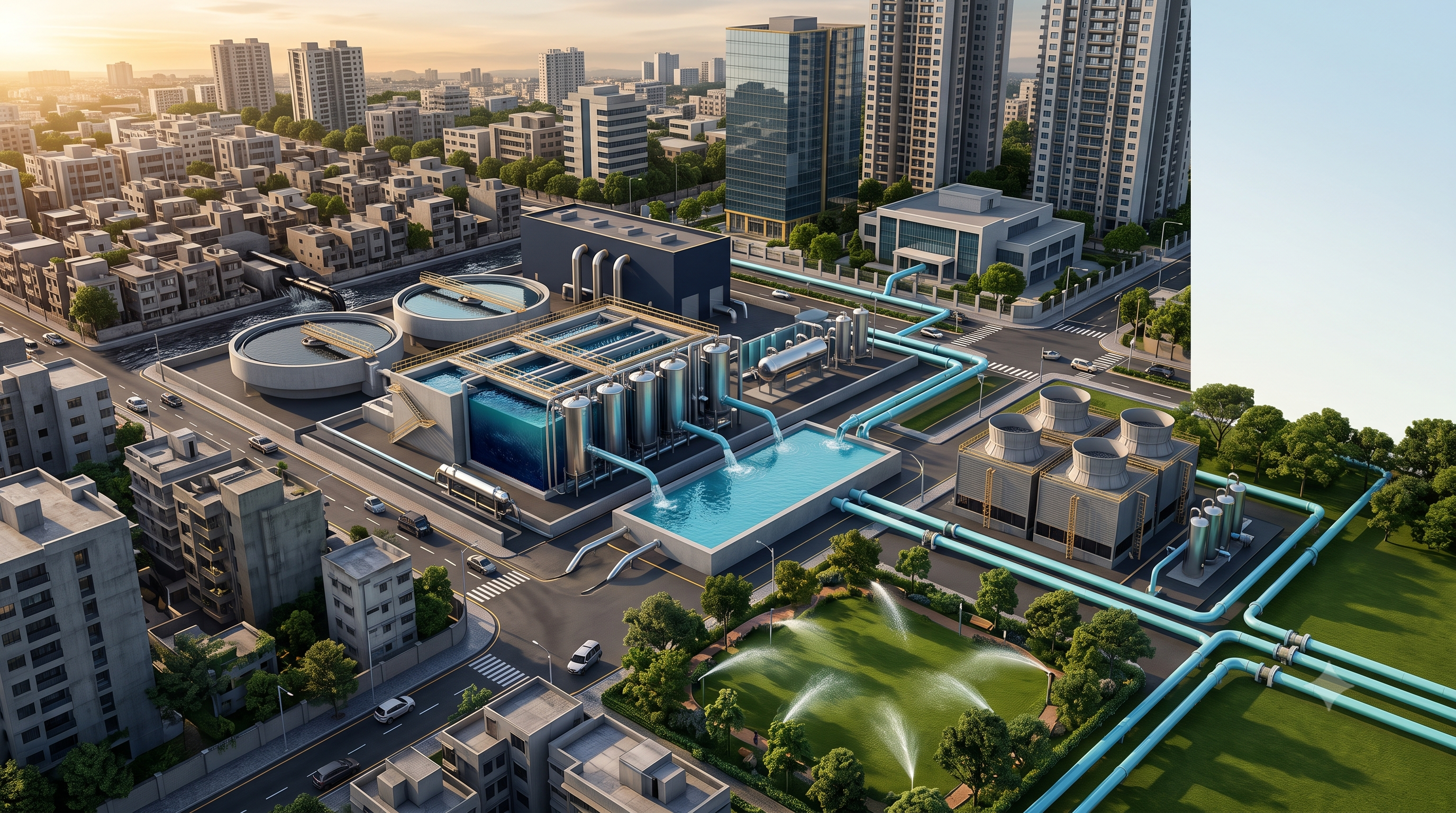
Four strategic pillars are necessary for a water-secure urban India. Mandatory Dual Piping: new high-rise developments require dual-piping systems — one for potable water, another for reclaimed water in flushing and landscaping applications. Decentralized STPs: community-level Sewage Treatment Plants reduce pumping costs across vast distances versus centralized infrastructure. Financial Incentives: governments should provide "Water Credits" or tax rebates to industries achieving zero liquid discharge or utilizing 100% recycled water. Standardization: the Ministry of Jal Shakti must enforce uniform "Class A" reclaimed water standards for non-potable urban applications, including public parks and construction.
The Central Government's "Safe Reuse and Management of Treated Wastewater" framework mandates all Class-I cities (population exceeding 100,000) to reuse a minimum of 20% of water consumption by 2025–26. With the Jal Jeevan Mission pursuing universal urban water supply, wastewater reclamation transitions from discretionary to obligatory. Treating 50% of the 72,000 MLD generated daily would create a "virtual river" requiring perpetual restoration — enabling India's urban centers to ensure sustained water access through Nagpur's pragmatism combined with Singapore and Israel's technological frameworks.